How the Women’s Suit Size Calculator Works
The calculator compares your bust, waist, and hip measurements with a women’s numeric size chart. It then uses your height to estimate whether petite, regular, or tall proportions may work best.


Use this women’s suit size calculator to estimate your jacket size, bottom size, and fit.
This women’s suit size calculator helps estimate your jacket size, bottom size, and height category from common body measurements. Enter your bust, waist, hips, and height, then add shoulder width and sleeve length if you want a more detailed fit estimate.
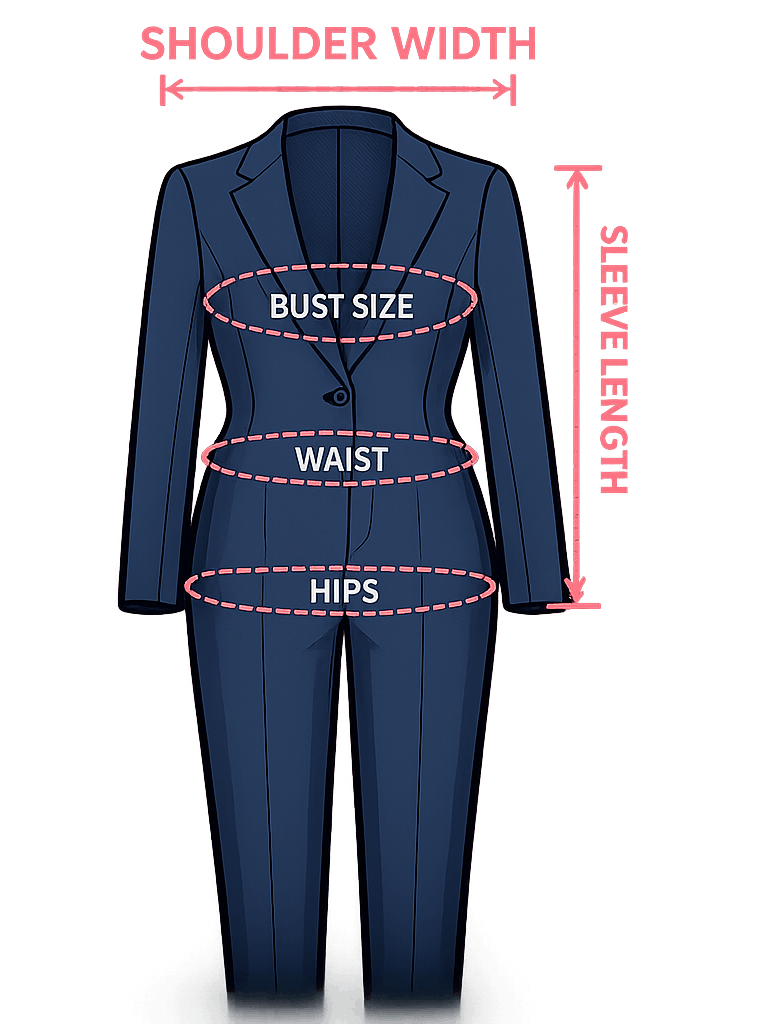
The calculator compares your bust, waist, and hip measurements with a women’s numeric size chart. It then uses your height to estimate whether petite, regular, or tall proportions may work best.
Women’s suit sizes are often shown as numeric sizes such as 4, 6, 8, 10, or 12. The best size depends on how the jacket fits through the bust and shoulders and how the trousers or skirt fit through the waist and hips.
Wrap a flexible measuring tape around the fullest part of your bust and keep it level across your back. The tape should be snug but not tight. Bust size is one of the most important measurements for women’s suit jacket sizing.
Measure around your natural waist, usually the narrowest part of your torso. Keep the tape level and breathe normally. Waist size helps estimate both jacket shaping and bottom size.
Stand naturally and measure around the fullest part of your hips and seat. Hip size is especially important for suit trousers, skirts, and longer jackets.
Stand barefoot against a wall and measure from the floor to the top of your head. Height helps the calculator estimate whether petite, regular, or tall proportions may fit better.
Shoulder width and sleeve length are optional, but they can make the result more useful. Shoulder width helps judge the top of the jacket, while sleeve length helps estimate whether tailoring may be needed at the wrist.
A women’s suit jacket should sit smoothly across the shoulders and bust without pulling. The waist should look shaped but not tight, and the sleeves should end cleanly near the wrist.
Suit trousers or skirts should fit comfortably at the waist and hips. If your waist and hip measurements point to different sizes, choose the size that fits the harder-to-tailor area and adjust from there.
This women’s suit size calculator gives an estimate based on common sizing patterns. Women’s suit sizing can vary by brand, cut, fabric, body shape, and fit preference, so always compare the result with the brand’s size chart when possible.
You can estimate your women’s suit size by measuring your bust, waist, hips, and height. The calculator uses those measurements to estimate your jacket size, bottom size, and height category.
Women’s suit size is often similar to dress size, but it is not always identical. Jackets, trousers, skirts, and dresses can fit differently depending on the brand and cut.
The most important measurements are bust, waist, hips, and height. Shoulder width and sleeve length are optional, but they can help refine the jacket fit.
Petite, regular, and tall categories are usually based on height. Petite may work better for shorter heights, regular fits many average-height women, and tall may work better for taller heights.
If you are between sizes, sizing up is often safer because a tailor can usually take in a garment more easily than add room to one that is too tight.